About
Approach
When light takes shape
For more than ten years, Benoit Marini has been conducting research into perception and into how light can take shape in space. His work stems from a particular attention to the phenomena that unsettle our perception, and to the way we observe them and try to understand them.
His creations play with our gaze to make luminous volumes appear and give them a physical presence before us. These forms move and transform before our eyes, sometimes giving the feeling that they come alive.
The viewer is then no longer simply facing an image: they share the same space, can move around the forms, observe them and go towards them.
Biography
Benoit Marini is a French artist whose work explores perception, light and our relationship to space. His practice was built at the crossroads of artistic creation and image technologies, outside a traditional academic path.
For more than ten years, he has been conducting research into how light can take shape in space. This research led him to develop his own means of expression, which uses light to make animated volumes appear directly in space.
His work draws on his interest in perceptual phenomena, optical illusions, mathematics and the observation of nature. In each he finds the same relationship between the wonder a phenomenon can provoke and the desire to understand its mechanisms.
This means of expression allows him to explore both forms drawn from his imagination and real phenomena that usually escape our gaze, and to offer an experience of them in the space we share.
In 2026, the Cité de l’architecture et du patrimoine presents Turbulence and hosts his new research, Invisible Imprints, devoted to the phenomena produced by architecture and to the possibility of perceiving them differently.
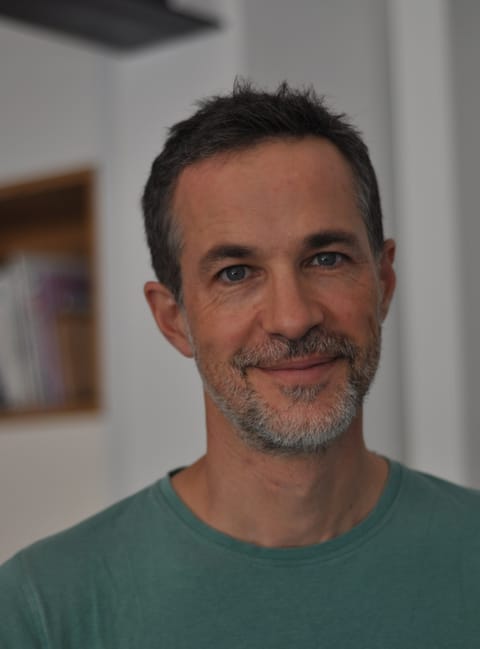
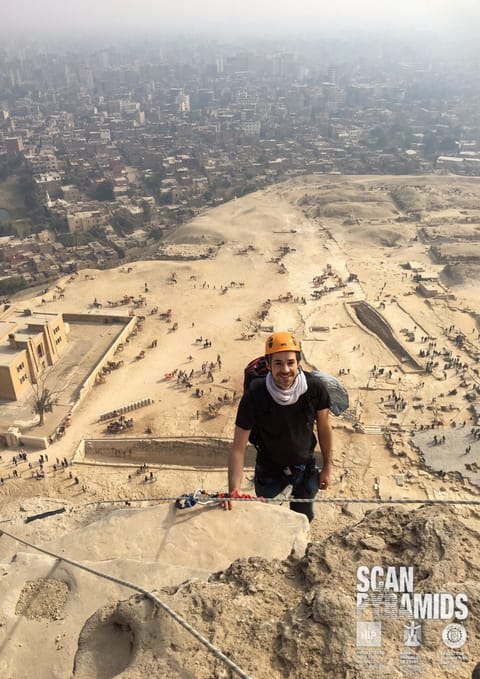
Portrait
From magic tricks to the pyramids
Since childhood, Benoit has been drawn to phenomena that provoke both wonder and curiosity. Magic, optical illusions, mathematics or the observation of nature feed the same reflex in him: to look, to marvel, then to try to understand how things work.
Later come lucid dreams, and with them another way of questioning what we perceive. Here again, what fascinates him lies where two movements meet: letting oneself be surprised by an experience, and seeking to understand its mechanisms.
Understanding has never spoiled the wonder. Rather the opposite. Once he understands how a phenomenon works, he wants to go further and imagine what could be created from its mechanisms.
He trains as an engineer at Arts et Métiers. He likes to say he chose that school because «arts was in its name. That is only half a joke.
For several years now, he has been taking part in the ScanPyramids mission, in Cairo and Dahshur, as a scientific advisor and 3D technologies expert. The aim is to study the inside of the pyramids without altering them, by combining several observation techniques able to reveal what the eye cannot see, such as muography or infrared thermography. This research leads to several discoveries and scientific publications. Benoit takes part in preparing the missions, in operations in the field, and in acquiring and processing the data used to produce the surveys and 3D models of some of the spaces studied.
A little over ten years ago, alongside this, he starts looking into whether light can hold in space. Taking the image out of the screen, giving it volume, making it appear in front of us. A question that is at first almost technical, is it possible?, and gradually becomes a means of expression. His first Light Sculptures are shown in 2024.
These volumes do not stay still. They move and transform, sometimes giving the feeling that they are coming to life. The viewer is no longer simply in front of an image: they share the same space as it, can move around it and go to meet it.
What he is after, in the end, is close to the state one can be in when watching a fire. You know what you are looking at. You watch anyway. Once the first moment has passed, the one where you wonder how what appears in front of you is possible, the question can gradually fade. What remains is the movement, the light and the pleasure of looking. That is the moment he cares about.
In 2026, Turbulence is presented at the Cité de l’architecture et du patrimoine. There Benoit also begins a new research project, Invisible Imprints of Heritage, on what a building produces around it that we do not see: the movements of the air, thermal circulations, the propagation of sound.
As a few years earlier in front of the pyramid of Khufu, it comes down to seeking to reveal what architecture does not directly show.
- 2024
- First Light Sculptures
- 2025
- Turbulence
- 2026
- Turbulence at the Cité de l’architecture et du patrimoine, Paris. Start of the research Invisible Imprints